帰還

アポロドーロス『ビブリオテーケー(ギリシア神話)』 摘要6 全29節

トロイアは落ちた。だが帰り着けた者は多くない。アテナは自軍のギリシャ勢に嵐を送り、偽の烽火が艦隊を岩に導く。そして帰り着いた総大将は、その日のうちに妻とその情夫に殺される。父を殺された子が母を殺し、復讐の女神たちに追われてアテナイの法廷に立つまで。アポロドーロス『ビブリオテーケー』摘要6 の全29節。これで摘要3から7まで、トロイア戦争からオデュッセウスの帰還までが通しで読める。

この訳について

この参考訳は、J. G. Frazer 英訳 (1921) を底本とする英語からの重訳であり、ギリシャ語原典から直接訳したものではない。 固有名は、英訳側の表記を日本語で一般的なギリシャ語系の表記に適宜改めた(Ulysses → オデュッセウス、the Furies → エリニュエス)。原英訳中の省略点は「……」で示した。訳者の注番号は表示から外している。

この訳は AI が英訳から作成し、別のAIが29節すべてを英文と突き合わせて 6箇所の誤りを直したもの。人間による通読校閲はまだ受けていない。 だから英訳を並べて読めるようにしてある。 詳しい素性

英訳は public domain。誤りを見つけたら、節番号を添えて知らせてほしい。

節ごとの「英文」からも開ける。

1出航をめぐる仲違い

小さな鉛の板状の像。腐食が進み、輪郭と表面の凹凸だけが残っている
6th–5th century BCE 盾と槍とアイギスを持つ女神の小像 この章に出てくる人物の図像。場面は対応していない → この人物のページ
E.6.1

そののち一同は集会を開き、アガメムノンとメネラオスが仲違いした。メネラオスはただちに船出すべきだと説き、アガメムノンは留まってアテナに犠牲を捧げるべきだと言い張った。海へ出たとき、ディオメデスとネストルとメネラオスは連れ立っていたが、前の二人は順調な航海をし、メネラオスは嵐に遭って残りの船を失い、五隻でエジプトに着いた。

英文

After these things they met in assembly, and Agamemnon and Menelaus quarrelled, Menelaus advising that they should sail away, and Agamemnon insisting that they should stay and sacrifice to Athena. When they put to sea, Diomedes, Nestor, and Menelaus in company, the two former had a prosperous voyage, but Menelaus was overtaken by a storm, and after losing the rest of his vessels, arrived with five ships in Egypt.

2予言者の勝負

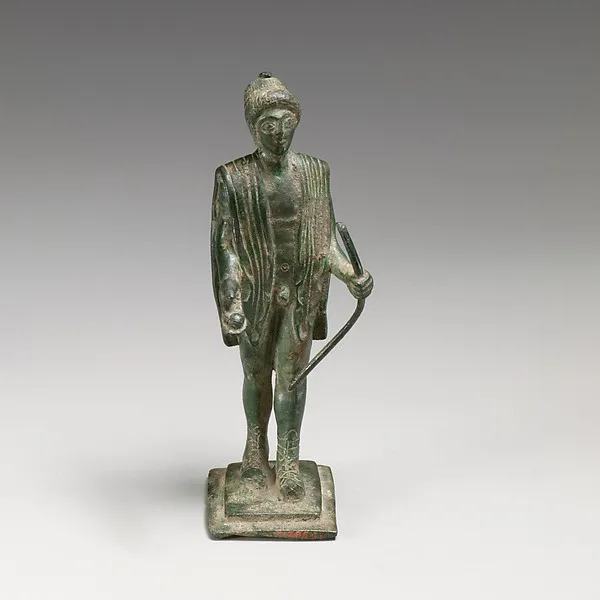
緑青に覆われた青銅像。衣をまとった人物が正面を向いて立ち、片手に細長いものを持っている
ca. 500 BCE アポロンの小像 この章に出てくる人物の図像。場面は対応していない → この人物のページ
E.6.2

アムフィロコス、カルカス、レオンテウス、ポダレイリオス、ポリュポイテスは船をイリオンに残し、陸路でコロフォンへ向かい、そこで予言者カルカスを葬った。自分よりも賢い予言者に出会えば死ぬ、と彼には告げられていたのである。

英文

But Amphilochus, and Calchas, and Leonteus, and Podalirius, and Polypoetes left their ships in Ilium and journeyed by land to Colophon, and there buried Calchas the diviner ; for it was foretold him that he would die if he met with a wiser diviner than himself.

E.6.3

さて、一行は予言者モプソスに宿を借りた。モプソスはアポロンとマントの子で、占いの術をめぐってカルカスと言い争った。その場に野生の無花果の木が生えており、カルカスが「この木はいくつ実をつけているか」と問うと、モプソスは「一万個と一ブッシェル、それにもう一個」と答えた。確かめると、そのとおりであった。

英文

Well, they were lodged by the diviner Mopsus, who was a son of Apollo and Manto, and he wrangled with Calchas about the art of divination. A wild fig-tree grew on the spot, and when Calchas asked, How many figs does it bear? Mopsus answered, Ten thousand, and a bushel, and one fig over, and they were found to be so.

E.6.4

次にモプソスが、孕んだ雌豚についてカルカスに問うた。「腹の中に仔は何匹いるか。いつ産むか」。カルカスは「八匹」と答えた。するとモプソスは微笑んで言った。「カルカスの占いは正確とは正反対だ。だが私はアポロンとマントの子として、正確な占いから来る鋭い目を人並みはずれて豊かに持っている。腹の中の仔はカルカスの言う八匹ではなく九匹であり、すべて雄で、明日の第六時に必ず産まれると私は見る」。そのとおりになったので、カルカスは失意のあまり死に、ノティオンに葬られた。

英文

And when Mopsus asked Calchas concerning a pregnant sow, How many pigs has she in her womb, and when will she farrow? Calchas answered, Eight. But Mopsus smiled and said, The divination of Calchas is the reverse of exact; but I, as a son of Apollo and Manto, am extremely rich in the sharp sight which comes of exact divination, and I divine that the number of pigs in the womb is not eight, as Calchas says, but nine, and that they are all male and will be farrowed without fail tomorrow at the sixth hour. So when these things turned out so, Calchas died of a broken heart and was buried at Notium.

3アテナの怒りと難破

小さな鉛の板状の像。腐食が進み、輪郭と表面の凹凸だけが残っている
6th–5th century BCE 盾と槍とアイギスを持つ女神の小像 この章に出てくる人物の図像。場面は対応していない → この人物のページ
E.6.5

犠牲を捧げたのち、アガメムノンは海へ出てテネドスに寄せた。だがテティスが来て、ネオプトレモスに二日待って犠牲を捧げるよう説き、彼は待った。ほかの者たちは海へ出て、テノスで嵐に遭った。アテナがゼウスに、ギリシャ勢へ嵐を送ってくれと願ったからである。多くの船が沈んだ。

英文

After sacrificing, Agamemnon put to sea and touched at Tenedos. But Thetis came and persuaded Neoptolemus to wait two days and to offer sacrifice; and he waited. But the others put to sea and encountered a storm at Tenos; for Athena entreated Zeus to send a tempest against the Greeks; and many ships foundered.

E.6.6

そしてアテナはアイアスの船に雷を投げつけた。船が砕けると、彼は岩まで無事にたどり着き、アテナがどう思おうと自分は助かったのだと言い放った。だがポセイドンが三叉戟で岩を打って割り、アイアスは海に落ちて死んだ。打ち上げられた亡骸は、テティスによってミュコノスに葬られた。

英文

And Athena threw a thunderbolt at the ship of Ajax; and when the ship went to pieces he made his way safe to a rock, and declared that he was saved in spite of the intention of Athena. But Poseidon smote the rock with his trident and split it, and Ajax fell into the sea and perished; and his body, being washed up, was buried by Thetis in Myconos.

E.6.7

ほかの者たちは夜のうちにエウボイアへ流され、そこでナウプリオスがカフェレウス山に烽火を焚いた。助かった味方の火だと思った一同は岸へ船を寄せ、船はカフェレウスの岩に砕け、多くの者が死んだ。

英文

The others being driven to Euboea by night, Nauplius kindled a beacon on Mount Caphareus; and they, thinking it was some of those who were saved, stood in for the shore, and the vessels were wrecked on the Capherian rocks, and many men perished.

4ナウプリオスの復讐

E.6.8

というのも、ナウプリオスとカトレウスの娘クリュメネとの子パラメデスが、オデュッセウスの計略によって石で打ち殺されていたからである。それを知ったナウプリオスはギリシャ勢のもとへ船で赴き、子の死の償いを求めた。

英文

For Palamedes, the son of Nauplius and Clymene daughter of Catreus, had been stoned to death through the machinations of Ulysses. And when Nauplius learned of it, he sailed to the Greeks and claimed satisfaction for the death of his son;

E.6.9

だが何も得られずに帰った。誰もがアガメムノン王に味方したからである。この王はパラメデス殺しでオデュッセウスの共犯だった。そこでナウプリオスはギリシャの沿岸をめぐり、将たちの妻が夫を裏切るよう仕向けた。クリュタイムネストラはアイギストスと、アイギアレイアはステネロスの子コメテスと、イドメネウスの妻メダはレウコスと通じた。

英文

but when he returned unsuccessful (for they all favoured King Agamemnon, who had been the accomplice of Ulysses in the murder of Palamedes), he coasted along the Grecian lands and contrived that the wives of the Greeks should play their husbands false, Clytaemnestra with Aegisthus, Aegialia with Cometes, son of Sthenelus, and Meda, wife of Idomeneus, with Leucus.

E.6.10

ところがレウコスは、神殿に逃げ込んだ娘クリシテュラもろとも彼女を殺した。そしてクレタから十の町を切り取って僭主となり、トロイア戦争のあとイドメネウスがクレタに上陸すると、これを追い払った。

英文

But Leucus killed her, together with her daughter Clisithyra, who had taken refuge in the temple; and having detached ten cities from Crete he made himself tyrant of them; and when after the Trojan war Idomeneus landed in Crete, Leucus drove him out.

E.6.11

ここまでがナウプリオスの先の仕掛けである。のちにギリシャ勢が故国へ帰る途上にあると知ると、彼はカフェレウス山——いまクシュロファゴスと呼ばれる山——で烽火を焚いた。港の火だと信じて岸へ寄せたギリシャ勢は、そこで難破した。

英文

These were the earlier contrivances of Nauplius; but afterwards, when he learned that the Greeks were on their way home to their native countries, he kindled the beacon fire on Mount Caphereus, which is now called Xylophagus; and there the Greeks, standing in shore in the belief that it was a harbor, were cast away.

5ネオプトレモスの行方

緑青に覆われた青銅像。衣をまとった人物が正面を向いて立ち、片手に細長いものを持っている
ca. 500 BCE アポロンの小像 この章に出てくる人物の図像。場面は対応していない → この人物のページ
E.6.12

テティスの勧めどおりテネドスに二日留まったのち、ネオプトレモスはヘレノスを伴い、陸路でモロッソイの地へ向かった。途中でフォイニクスが死に、ネオプトレモスはこれを葬った。そしてモロッソイ人を戦で破って王となり、アンドロマケとのあいだにモロッソスをもうけた。

英文

After remaining in Tenedos two days at the advice of Thetis, Neoptolemus set out for the country of the Molossians by land with Helenus, and on the way Phoenix died, and Neoptolemus buried him ; and having vanquished the Molossians in battle he reigned as king and begat Molossus on Andromache. And

E.6.13

ヘレノスはモロッシアに町を建てて住み、ネオプトレモスは自分の母デイダメイアを彼の妻として与えた。ペレウスがアカストスの子らにフティアを追われて死ぬと、ネオプトレモスは父の王国を継いだ。

英文

Helenus founded a city in Molossia and inhabited it, and Neoptolemus gave him his mother Deidamia to wife. And when Peleus was expelled from Phthia by the sons of Acastus and died, Neoptolemus succeeded to his father's kingdom.

E.6.14

オレステスが狂ったとき、ネオプトレモスはその妻ヘルミオネを連れ去った。ヘルミオネはかつてトロイアで彼に婚約させられていたのである。そのためネオプトレモスはデルフォイでオレステスに討たれた。ただし、こう言う者もいる。彼は父の死の償いをアポロンに求めてデルフォイへ行き、奉納物を荒らして神殿に火を放ったので、そのためにフォキスのマカイレウスに討たれたのだ、と。

英文

And when Orestes went mad, Neoptolemus carried off his wife Hermione, who had previously been betrothed to him in Troy ; and for that reason he was slain by Orestes at Delphi. But some say that he went to Delphi to demand satisfaction from Apollo for the death of his father, and that he rifled the votive offerings and set fire to the temple, and was on that account slain by Machaereus the Phocian.

6散り散りになった者たち

E.6.15名前の一覧

さまよいののち、ギリシャ勢は各地に上陸して住みついた。ある者はリビュアに、ある者はイタリアに、ある者はシケリアに、ある者はイベリアに近い島々に、ある者はサンガリオス河のほとりに、ある者はキュプロスにも住みついた。カフェレウスで難破した者たちも、ある者はこちらへ、ある者はあちらへと流された。グネウスはリビュアへ行った。テッサロスの子アンティフォスはペラスゴイ人のもとへ行き、その地を手に入れてテッサリアと名づけた。ピロクテテスはイタリアのカンパニア人のもとへ行った。フィディッポスはコス勢とともにアンドロスに、アガペノルはキュプロスに住みつき、ほかの者たちもそれぞれの地に住みついた。〔a〕アポロドーロスほかは次のように言う。グネウスは自分の船を捨て、リビュアのキニュプス河に来てそこに住んだ。メゲスとプロトオスは多くの者とともにエウボイアのカフェレウスで難破し……プロトオスがカフェレウスで難破すると、ともにいたマグネシア勢はクレタへ流されてそこに住みついた。(ツェツェス『リュコフロン注解』902)〔b〕イリオンの落城ののち、メネステウス、フィディッポスとアンティフォス、エレフェノルの人々、そしてピロクテテスは、ミマスまで一緒に航海した。それからメネステウスはメロスへ行って王となった。そこの王ポリュアナクスが死んでいたからである。テッサロスの子アンティフォスはペラスゴイ人のもとへ行き、その地を手に入れてテッサリアと名づけた。フィディッポスはコス勢とともにまずアンドロスへ、次いでキュプロスへ流され、そこに住みついた。エレフェノルはトロイアで死んだが、その人々はイオニア湾に流れ着き、エペイロスのアポロニアに住みついた。トレポレモスの人々はクレタに寄せ、それから風に流されてイベリアの島々に住みついた……プロテシラオスの人々はカナストロンの平野に近いペレネに流れ着いた。ピロクテテスはイタリアのカンパニアへ流され、ルカニア人と戦ったのち、クロトンとトゥリウムに近いクリミッサに住みついた。そしてさまよいを終えて「さすらいのアポロン(アライオス)」の聖域を建て、そこに自分の弓も奉納した、とエウフォリオンは言う。(ツェツェス『リュコフロン注解』911)〔c〕ナウァイトスはイタリアの河である。アポロドーロスほかによれば、その名の由来はこうである。イリオンが落ちたのち、ラオメドンの娘たちでプリアモスの姉妹にあたるアイテュラ、アステュオケ、メデシカステが、ほかの捕らわれの女たちとともにイタリアのその地におり、ギリシャで奴隷にされることを恐れて船に火を放った。そこから河はナウァイトスと呼ばれ、女たちはナウプレスティデス(船を焼いた女たち)と呼ばれた。船を失った、女たちとともにいたギリシャ人は、そこに住みついた。(ツェツェス『リュコフロン注解』921)

After their wanderings the Greeks landed and settled in various countries, some in Libya, some in Italy, others in Sicily, and some in the islands near Iberia, others on the banks of the Sangarius river; and some settled also in Cyprus. And of those that were shipwrecked at Caphereus, some drifted one way and some another. Guneus went to Libya; Antiphus, son of Thessalus, went to the Pelasgians, and, having taken possession of the country, called it Thessaly. Philoctetes went to the Campanians in Italy; Phidippus with the Coans settled in Andros, Agapenor in Cyprus, and others elsewhere. [E.6.15a] Apollodorus and the rest say as follows. Guneus left his own ships, and having come to the Cinyps river in Libya he dwelt there. But Meges and Prothous, with many others, were cast away at Caphereus in Euboea . . . and when Prothous was shipwrecked at Caphereus, the Magnesians with him drifted to Crete and settled there. (Tzetzes, Scholia on Lycophron , 902) [E.6.15b] After the sack of Ilium, Menestheus, Phidippus and Antiphus, and the people of Elephenor, and Philoctetes sailed together as far as Mimas. Then Menestheus went to Melos and reigned as king, because the king there, Polyanax, had died. And Antiphus the son of Thessalus went to the Pelasgians, and having taken possession of the country he called it Thessaly. Phidippus with the Coans was driven first to Andros, and then to Cyprus, where he settled. Elephenor died in Troy, but his people were cast away in the Ionian gulf and inhabited Apollonia in Epirus. And the people of Tlepolemus touched at Crete; then they were driven out of their course by winds and settled in the Iberian islands . . . The people of Protesilaus were cast away on Pellene near the plain of Canastrum. And Philoctetes was driven to Campania in Italy, and after making war on the Lucanians, he settled in Crimissa, near Croton and Thurium ; and, his wanderings over, he founded a sanctuary of Apollo the Wanderer (Alaios), to whom also he dedicated his bow, as Euphorion says. (Tzetzes, Scholia on Lycophron , 911) [E.6.15c] Navaethus is a river of Italy. It was called so, according to Apollodorus and the rest, because after the capture of Ilium the daughters of Laomedon, the sisters of Priam, to wit, Aethylla, Astyoche, and Medesicaste, with the other female captives, finding themselves in that part of Italy, and dreading slavery in Greece, set fire to the vessels; whence the river was called Navaethus and the women were called Nauprestides; and the Greeks who were with the women, having lost the vessels, settled there. (Tzetzes, Scholia on Lycophron , 921)
7フュリスとデモフォン

E.6.16

デモフォンは少数の船でトラキアのビサルタイ人の地に寄せた。そこで王の娘フュリスが彼に恋し、父は王国を持参にして娘を彼に嫁がせた。だがデモフォンは故国へ帰りたがり、幾度も乞われたすえ、必ず戻ると誓って去っていった。フュリスは「九つの道」と呼ばれる場所まで彼を送り、小箱を渡して、その中には母なるレアの聖物が入っているから、彼女のもとへ帰る望みをすべて捨てるまでは開けてはならないと告げた。

英文

Demophon with a few ships put in to the land of the Thracian Bisaltians, and there Phyllis, the king's daughter, falling in love with him, was given him in marriage by her father with the kingdom for her dower. But he wished to depart to his own country, and after many entreaties and swearing to return, he did depart. And Phyllis accompanied him as far as what are called the Nine Roads, and she gave him a casket, telling him that it contained a sacrament of Mother Rhea, and that he was not to open it until he should have abandoned all hope of returning to her.

E.6.17

デモフォンはキュプロスへ行き、そこに住んだ。約束の時が過ぎると、フュリスはデモフォンに呪いをかけて自ら命を絶った。デモフォンが小箱を開けると、恐ろしさに打たれて馬に飛び乗り、狂ったように駆けて最期を迎えた。馬がつまずいて投げ出され、自分の剣の上に落ちたのである。彼の人々はキュプロスに住みついた。

英文

And Demophon went to Cyprus and dwelt there. And when the appointed time was past, Phyllis called down curses on Demophon and killed herself; and Demophon opened the casket, and, being struck with fear, he mounted his horse and galloping wildly met his end; for, the horse stumbling, he was thrown and fell on his sword. But his people settled in Cyprus.

8託宣に従った者たち

E.6.18

ポダレイリオスはデルフォイへ行き、どこに住むべきかを託宣に問うた。「取り巻く天が落ちてきても害を受けずにすむ町に住め」との答えを得て、地平のぐるりを山に囲まれたカリアのケルソネソスのその場所に住みついた。

英文

Podalirius went to Delphi and inquired of the oracle where he should settle; and on receiving an oracle that he should settle in the city where, if the encompassing heaven were to fall, he would suffer no harm, he settled in that place of the Carian Chersonnese which is encircled by mountains all round the horizon.

E.6.19

アルクマイオンの子アムフィロコスは——一説にはトロイアへ遅れて着いたという——嵐でモプソスの住まいへ流された。そして一説には、二人は王位をめぐって一騎打ちをし、相討ちになった。

英文

Amphilochus son of Alcmaeon, who, according to some, arrived later at Troy, was driven in the storm to the home of Mopsus; and, as some say, they fought a single combat for the kingdom, and slew each other.

9ロクリスの乙女たち

小さな鉛の板状の像。腐食が進み、輪郭と表面の凹凸だけが残っている
6th–5th century BCE 盾と槍とアイギスを持つ女神の小像 この章に出てくる人物の図像。場面は対応していない → この人物のページ
E.6.20

ロクリス勢はやっとのことで故国に帰り着いた。三年後、ロクリスが疫病に見舞われると、「イリオンでアテナをなだめ、千年のあいだ嘆願者として乙女を二人ずつ送れ」という託宣を受けた。籤は最初にペリボイアとクレオパトラに当たった。

英文

The Locrians regained their own country with difficulty, and three years afterwards, when Locris was visited by a plague, they received an oracle bidding them to propitiate Athena at Ilium and to send two maidens as suppliants for a thousand years. The lot first fell on Periboea and Cleopatra.

E.6.21

二人がトロイアへ来ると、土地の者たちに追い立てられ、聖域に逃げ込んだ。女神に近づくことはせず、聖域を掃き、水を撒いた。神殿から外へ出ず、髪は短く刈られ、一枚の衣だけを着て、履物は履かなかった。

英文

And when they came to Troy they were chased by the natives and took refuge in the sanctuary. And they did not approach the goddess, but swept and sprinkled the sanctuary; and they did not go out of the temple, and their hair was cropped, and they wore single garments and no shoes.

E.6.22

最初の乙女たちが死ぬと、別の乙女たちが送られた。彼女たちは夜のうちに町へ入った。境内の外で姿を見られれば剣にかけられたからである。のちには乳母をつけた赤子が送られた。千年が過ぎ、フォキス戦争ののち、嘆願者を送ることはやめられた。

英文

And when the first maidens died, they sent others; and they entered into the city by night, lest, being seen outside the precinct, they should be put to the sword; but afterwards they sent babes with their nurses. And when the thousand years were passed, after the Phocian war they ceased to send suppliants.

10アガメムノンの死

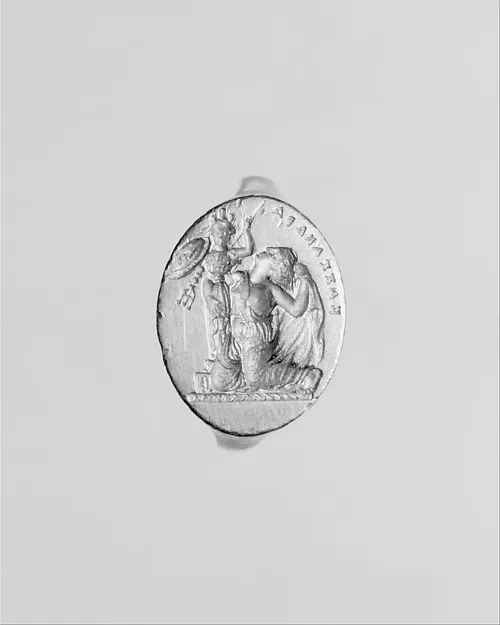
楕円形の印面を写した図。二人の人物が立ち、周囲にギリシャ文字が並ぶ
ca. 400–380 BCE カサンドラを刻んだ指輪の印面 この章に出てくる人物の図像。場面は対応していない → この人物のページ
E.6.23

アガメムノンがカサンドラを連れてミュケナイに帰り着くと、アイギストスとクリュタイムネストラに殺された。クリュタイムネストラが、袖口も首を通す穴もない衣を彼に渡し、彼がそれを着ようとしているところを斬り伏せたのである。そしてアイギストスがミュケナイを治めた。二人はカサンドラも殺した。

英文

After Agamemnon had returned to Mycenae with Cassandra, he was murdered by Aegisthus and Clytaemnestra; for she gave him a shirt without sleeves and without a neck, and while he was putting it on he was cut down, and Aegisthus reigned over Mycenae. And they killed Cassandra also.

11オレステスの復讐と裁き

E.6.24

だがアガメムノンの娘の一人エレクトラは、弟オレステスをひそかに逃がし、フォキスのストロフィオスに預けて育てさせた。ストロフィオスは自分の子ピュラデスと一緒に彼を育てた。オレステスは成人すると、デルフォイへ赴き、父を殺した者たちに報いてよいかを神に問うた。

英文

But Electra, one of Agamemnon's daughters, smuggled away her brother Orestes and gave him to Strophius, the Phocian, to bring up; and he brought him up with Pylades, his own son. And when Orestes was grown up, he repaired to Delphi and asked the god whether he should take vengeance on his father's murderers.

E.6.25

神は許した。そこで彼はピュラデスを伴ってひそかにミュケナイへ向かい、母とアイギストスの二人を殺した。そして幾ほども経たぬうちに狂気に襲われ、復讐の女神たちに追われて、アテナイへ赴きアレイオス・パゴスで裁かれた。訴えたのは復讐の女神たちだとも、テュンダレオスだとも、アイギストスとクリュタイムネストラの娘エリゴネだとも言われる。裁きの票が同数だったので、彼は放免された。

英文

The god gave him leave, so he departed secretly to Mycenae in company with Pylades, and killed both his mother and Aegisthus. And not long afterwards, being afflicted with madness and pursued by the Furies, he repaired to Athens and was tried in the Areopagus. He is variously said to have been brought to trial by the Furies, or by Tyndareus, or by Erigone, daughter of Aegisthus and Clytaemnestra; and the votes at his trial being equal he was acquitted.

12タウロイ人の地

E.6.26

この病をどうすれば免れるかと問うと、神は「タウロイ人の地にある木像を持ち帰れば免れる」と答えた。タウロイ人はスキュタイ人の一派で、異国の者を殺して聖なる火に投げ込む。その火は境内にあり、ある岩を通って冥界から立ち上っていた。

英文

When he inquired how he should be rid of his disorder, the god answered that he would be rid of it if he should fetch the wooden image that was in the land of the Taurians. Now the Taurians are a part of the Scythians, who murder strangers and throw them into the sacred fire, which was in the precinct, being wafted up from Hades through a certain rock.

E.6.27

オレステスがピュラデスとともにタウロイ人の地へ来ると、見つかって捕らえられ、縛られて王トアスの前へ引き出された。王は二人とも巫女のもとへ送った。だが、タウロイ人のもとで巫女を務めていた姉に見分けられ、オレステスは姉とともに逃げ、木像を持ち去った。木像はアテナイへ運ばれ、いまタウロポロスの像と呼ばれている。ただし、オレステスは嵐でロドス島へ流されたと言う者もおり、託宣に従って木像は城壁に安置して奉納されたという。

英文

So when Orestes was come with Pylades to the land of the Taurians, he was detected, caught, and carried in bonds before Thoas the king, who sent them both to the priestess. But being recognized by his sister, who acted as priestess among the Taurians, he fled with her, carrying off the wooden image. It was conveyed to Athens and is now called the image of Tauropolus. But some say that Orestes was driven in a storm to the island of Rhodes, . . . and in accordance with an oracle the image was dedicated in a fortification wall.

E.6.28

そしてミュケナイへ来ると、彼は姉エレクトラをピュラデスに嫁がせ、自らはヘルミオネを——一説にはエリゴネを——娶ってテイサメノスをもうけ、アルカディアのオレステイオンで蛇に咬まれて死んだ。

英文

and having come to Mycenae, he united his sister Electra in marriage to Pylades, and having himself married Hermione, or, according to some, Erigone, he begat Tisamenus, and was killed by the bite of a snake at Oresteum in Arcadia.

13メネラオスの帰還

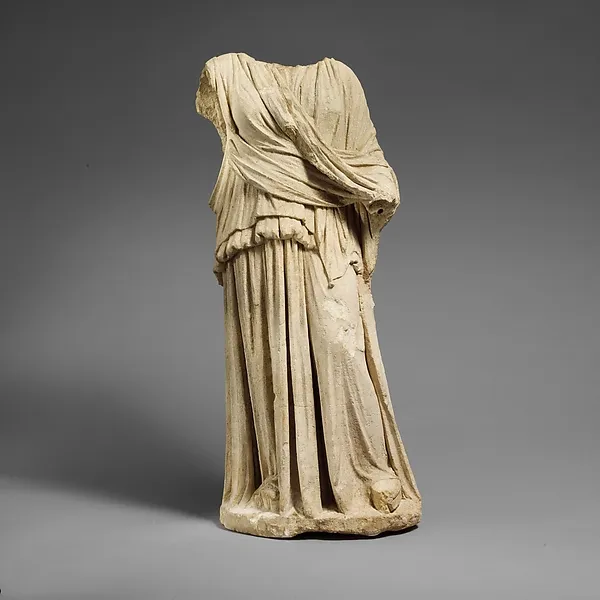
石灰岩の女性立像。厚い衣が縦に襞をつくる。頭部と両腕は失われている
ca. 330–200 BCE ヘラまたはデメテルの立像 この章に出てくる人物の図像。場面は対応していない → この人物のページ
E.6.29

メネラオスは全部で五隻を率いてアッティカの岬スニオンに寄せ、そこからまた風にクレタへ流され、はるかに漂って、リビュア、フェニキア、キュプロス、エジプトをさまよい、多くの財宝を集めた。一説には、エジプト王プロテウスのもとでヘレネを見つけたという。それまでメネラオスが連れていたのは、雲でできた彼女の幻だったのである。八年さまよったのちミュケナイに入港し、そこで父の仇を討ったオレステスに会った。そしてスパルタへ来て自分の王国を取り戻し、ヘラによって不死の身とされ、ヘレネとともにエリュシオンの野へ行った。

英文

Menelaus, with five ships in all under his command, put in at Sunium, a headland of Attica; and being again driven thence by winds to Crete he drifted far away, and wandering up and down Libya, and Phoenicia, and Cyprus, and Egypt, he collected much treasure. And according to some, he discovered Helen at the court of Proteus, king of Egypt; for till then Menelaus had only a phantom of her made of clouds. And after wandering for eight years he came to port at Mycenae, and there found Orestes, who had avenged his father's murder. And having come to Sparta he regained his own kingdom, and being made immortal by Hera he went to the Elysian Fields with Helen.

英訳の底本は アポロドーロス『ビブリオテーケー(ギリシア神話)』、J. G. Frazer 英訳 (1921)。 発表から百年以上が経ち、著作権の保護期間が満了している。 底本のテキスト

日本語は英訳からの参考訳で、ギリシャ語原典からの直接訳ではない。 誤りを見つけたら直すので、節番号(摘要6 全29節)を添えて知らせてほしい。

出典と著作権について →

ギリシャ神話の関係図を見る →